How Do You Build Negotiation Capability?
Why training is only the starting point - and how learning, practice, application and coaching combine to create lasting capability.
Negotiation training can create a powerful foundation. It gives people a common language, introduces skills and techniques they may never previously have considered, and provides the opportunity to practise away from the pressure of a real commercial negotiation.
But learning is only the beginning of negotiation capability.
The bigger question is what happens afterwards. How do we reinforce what people have learned, help them practise, apply those skills to real situations and provide coaching that reflects what they actually need?
That, to me, is where negotiation training starts to become negotiation capability.
The lesson I learned from advanced training
Many years ago, while working for a negotiation training provider, we noticed something interesting. Participants who had completed our flagship programme two or three years earlier kept coming back asking for more.
Like many providers, we assumed they wanted a more advanced course, so we built one.
The original programme already contained well over 100 negotiation skills, techniques and concepts. The follow-on programme was designed to reinforce and build on those foundations through more demanding negotiations, behavioural self-assessment, recorded negotiation analysis and one-to-one coaching.
The original programme was widely regarded as transformational. The follow-on programme was also well received, but one comment kept coming back:
“I liked it, but it wasn’t as good as the first programme.”
At first, that was frustrating. Eventually, I realised it wasn’t really a criticism of the second programme. It was telling us something more important about how people develop.
The first programme had done exactly what it was supposed to do: it had created a strong common foundation. The challenge was that, once that foundation existed, people began to face more specific negotiation issues that they wanted help with.
The better the foundation, the greater the need for personalised development
Once people returned to their roles, their development paths naturally diverged.
Some negotiated every day, while others did so only occasionally. Some bought from suppliers, others sold to customers. Some handled internal negotiations, while others dealt with regulators, strategic partners or major clients.
As their experience and responsibilities changed, so did the areas they needed to strengthen.
Wherever possible, I personalised the experience. I changed examples, adapted discussions and used coaching sessions to focus on the commercial situations people were actually facing.
The more personalised the development became, the more useful it tended to be.
But one challenge remained:
the structure of the advanced programme remained broadly the same while the negotiators themselves continued to change.
That changed the way I thought about negotiation development. The question was no longer simply how to provide more training. It was how to build negotiation capability.
So, what is negotiation capability?
To me, negotiation capability is not simply what somebody knows.
It is what they can consistently and flexibly apply under real commercial pressure to achieve considered, achievable and sustainable outcomes.
Someone may understand a negotiation technique perfectly but fail to use it when challenged. Another person may know they should trade rather than concede, yet still give something away when the pressure increases. Someone else may prepare thoroughly but struggle to adapt when the negotiation moves unexpectedly.
Learning therefore matters enormously, but it is just the start of the capability journey.
The foundation might come from classroom training, digital learning, blended development or a combination of all three.
What matters is what happens next.
Capability develops when learning is repeatedly tested, applied and refined.
Why personalised development needs coaching
For many years, coaching was the most effective answer I found because it started with the individual rather than the programme.
It could focus on the particular behaviours, commercial situations and development needs that mattered to that person.
The limitation was scale. It simply was not practical to provide high-quality individual coaching to everybody, every time they needed it.
That is why organisations understandably created advanced programmes, masterclasses, refreshers and follow-on courses. All can add value, but the challenge remains: how do you make personalised development available more consistently and closer to the point at which people actually need it?
For a long time, there was no obvious answer.
The advent of AI changes that.
Not because it replaces training, coaching or human judgement, but because it makes personalised reinforcement, practice and support possible at a scale that was previously difficult to achieve.
How can AI support negotiation capability?
AI will not change what good negotiation looks like.
The principles of skilled negotiation are still grounded in human behaviour, commercial judgement and practical experience. Experienced negotiators still define what good looks like.
What AI changes is our ability to extend that expertise.
It can help reinforce learning, provide personalised opportunities to practise, create realistic negotiation scenarios, offer feedback around individual behaviour and support preparation for real negotiations without requiring a trainer or coach to be present every time.
That creates the potential to make development both more continuous and more personal. It also requires judgement about where AI is most useful.
Practice can be relatively controlled. A scenario can contain defined roles, objectives, constraints and commercial pressures, providing a safe environment in which somebody can experiment, make mistakes and receive feedback.
Real negotiations are less predictable. Information is often incomplete, motivations are uncertain, relationships vary in strength, power can shift and commercial context can change the meaning of what appears to be a sensible move.
Certain behaviours can be effective in one negotiation and inappropriate in another.
So, the opportunity is not to use AI to replace judgement.
It is to use AI to help people develop better judgement.
Building capability means connecting the stages
I increasingly believe negotiation capability is built through four connected elements:
Learning. Practice. Application. Coaching.
Learning creates the foundation.
Practice helps turn understanding into judgement.
Application connects development to real negotiations.
Coaching helps identify what worked, what did not and what needs strengthening next.
The real value lies in the connection between those stages.
Someone learns something, practises it, applies it and receives feedback. That feedback loop influences what they need to work on next, and the cycle continues.
The point is not simply to provide more development. It is to connect each stage so that what happens in one informs what happens next.
From capability model to practical application
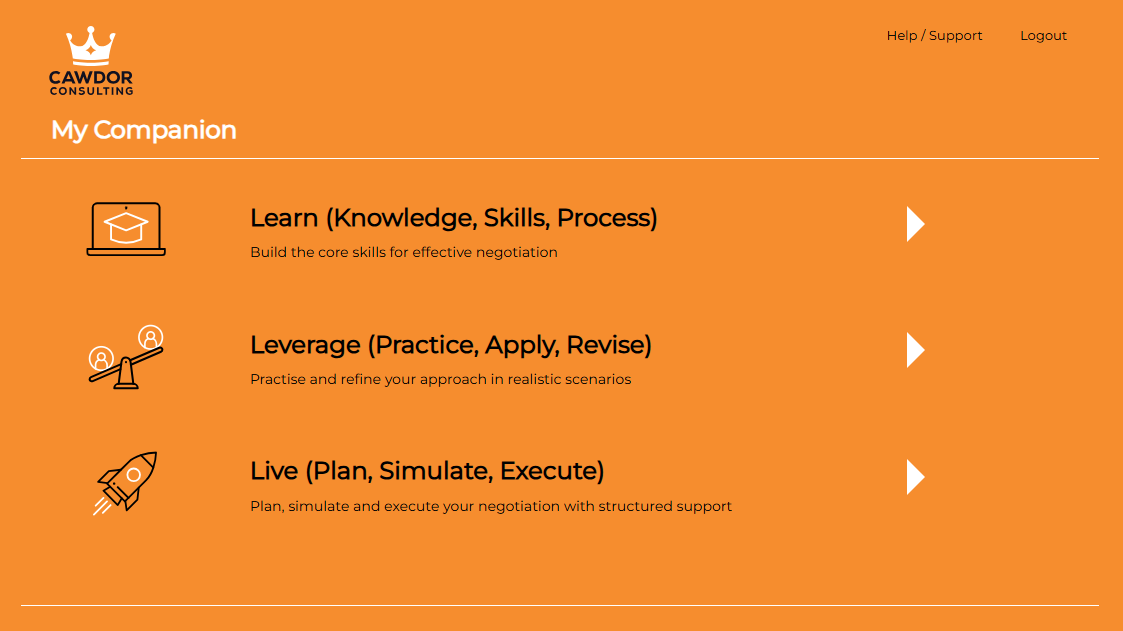
This thinking eventually became the model behind the Cawdor Companion.
We built it around three connected stages: LEARN, LEVERAGE and LIVE.
LEARN builds the knowledge, skills and process that create the foundation. LEVERAGE allows people to practise, apply and revise those skills in realistic scenarios. LIVE helps them plan, simulate and execute the negotiations they are actually preparing for.
Coaching and reinforcement sit across that journey, helping people understand what worked, what needs strengthening and what they should focus on next.
Where strong negotiation training already exists, the Companion can build around it by adding personalised practice, application, reinforcement and coaching.
Where that foundation does not yet exist, the learning journey can begin within the platform itself.
What matters is not where an organisation starts. It is whether the different elements are connected in a way that helps people continue developing.
From training events to commercial performance
Ultimately, organisations do not invest in negotiation development because they want people to complete courses.
They invest because they want people to make better commercial decisions.
They want stronger preparation, greater confidence, better management of value, more effective conversations and better commercial outcomes.
Training can create the foundation for all of those things. The opportunity now is to connect learning much more closely with practice, application and coaching so that development continues long after the initial intervention has finished.
For decades, the negotiation industry has become increasingly sophisticated in the way it teaches people how to negotiate.
The next challenge is to become equally sophisticated in the way we help them continue developing.
Learning builds the foundation.
Capability develops the negotiator.
Continue Exploring
Prepare with the Companion
Build confidence with realistic AI negotiation simulations before the real conversation.
Why AI Is Uniquely Suited to Negotiation Skills
Why training is only the starting point - and how learning, practice, application and coaching combine to create lasting capability.
Meet Sam Macbeth
Discover the experience, thinking and principles behind Cawdor Consulting and the Companion.